
Table of Contents
- What is a classic car? The short answer
- How old does a car have to be to be a classic in the UK?
- How many classic cars are there in the UK?
- What happens when a car turns 40
- How old is a classic car in other countries?
- What age is a classic car for insurance, and at auction?
- What the hobby has always said
- Rarer than an E-type: the survival test
- Electric conversions and modified cars
- So what makes a classic car in 2026?
- Questions people ask
- How I counted, and the data
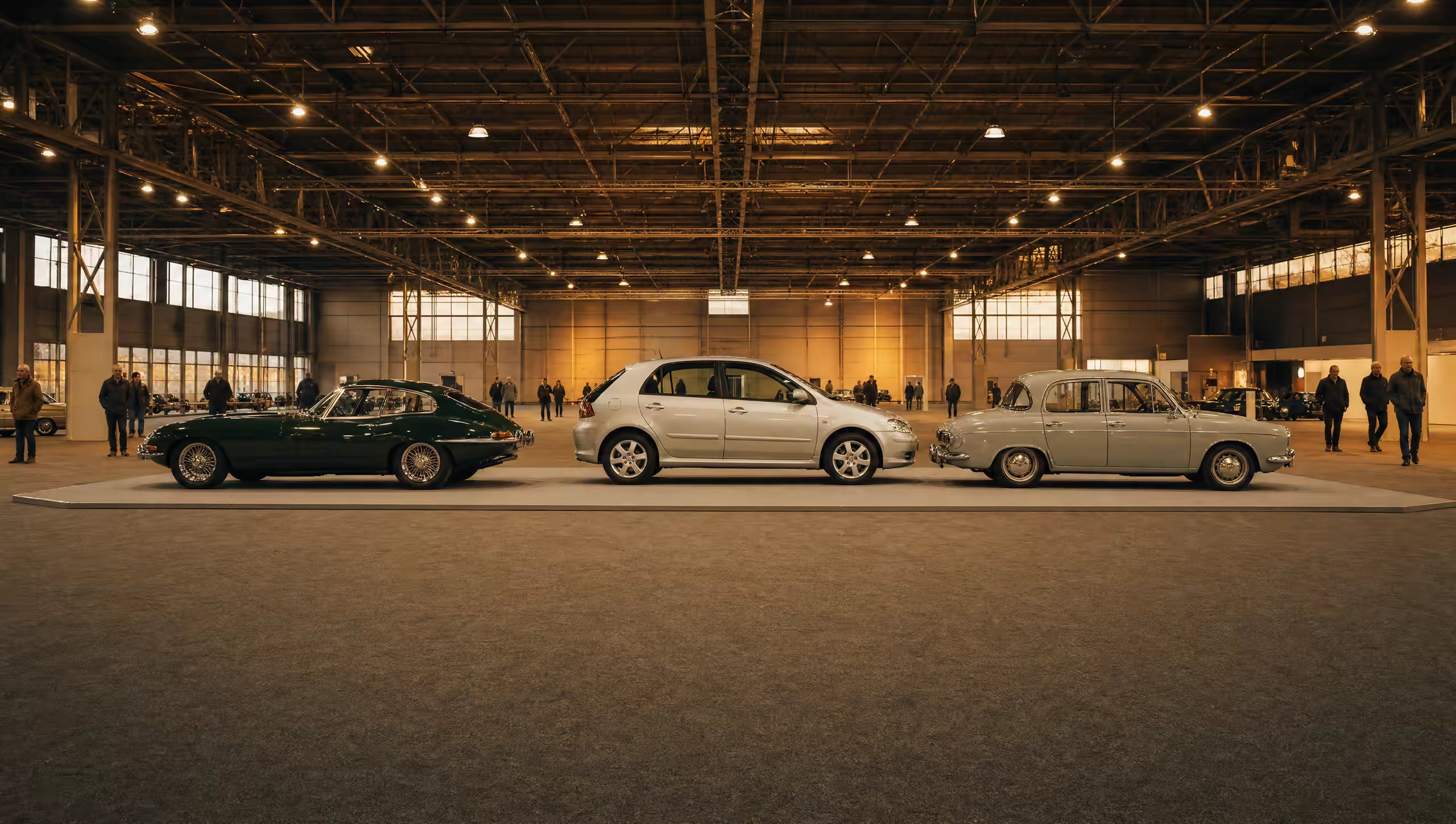
There is a 2004 Ford Focus ST170 on a club stand at the NEC this weekend. It is an estate, it is 22 years old, and the Focus Mk1 Preservation Club has brought it to the Lancaster Insurance Classic Motor Show to sit in the same building as a 1921 Standard and the original Jaguar XJ220 concept. I would bet a decent lunch that somebody has already stood in front of it and announced that it is not a classic.
The show saw this coming. On the Meet the Experts stage in Hall 5 there is a half-hour session every afternoon called What makes a 'classic car' in 2026? It runs at 3pm on Friday, 2pm on Saturday and 2.30pm on Sunday, and the timetable promises to "put a list of cars to the audience as to whether they class them as classics in their heads". A show of hands, in other words.
I thought the audience might like some numbers to go with its hands. So I have been through every official rule I could find, here and abroad, that puts an age on a classic car, and checked each one against the law or the official page. Then I counted how many British cars each rule lets in, using the government's licensing records for 34.5 million cars. Then I went through 1,759 cars sold at UK classic auctions this year, to see how old the cars people actually pay for are.
The short version is that there is no single answer and there never has been. Twenty rules put the line anywhere from 15 years old to 50. Which one you pick changes the number of classics on British roads from about 355,000 to more than six million. And the records show something I did not expect. When a year's worth of cars turns 40 and goes tax free, the number of them on the road roughly doubles.
What is a classic car? The short answer
In Britain there is no legal definition of a classic car. There are age tests instead, and they disagree. A car is historic for road tax and the MOT at 40 years old, a historic vehicle by the international definition at 30, and a classic to HMRC and the big specialist insurers at 15. Abroad the line runs from 15 years in Canada to 50 in India.
If you only want to know where your own car stands this year, here is the table.
| Built | Age in 2026 | Who counts it as a classic |
|---|---|---|
| 1985 or earlier | 41 and up | The DVLA. Road tax is free in the historic class, there is no MOT unless the car has been substantially changed, and London's ULEZ lets it in once it is in the class |
| 1986 | 40 | No MOT from the day it turns 40. Road tax is free from 1 April 2027 |
| 1987 to 1996 | 30 to 39 | A historic vehicle to FIVA (the world federation of old car clubs), EU law and the FBHVC. Scotland's low emission zones let it in if it is original |
| 1997 to 2001 | 25 to 29 | Welcome at Hagerty's Festival of the Unexceptional, which reached 2001 this summer. Old enough to import into America and Australia |
| 2002 to 2005 | 21 to 24 | A "youngtimer" in FIVA's rule book, which covers 20 to 29 years. Eligible for the NEC show's own Pride of Ownership contest, open to anything built before 2006 |
| 2006 to 2011 | 15 to 20 | HMRC, if it is a company car worth £15,000 or more. Hagerty and Lancaster will consider it for a classic policy |
Nearly all of these come with conditions, and our guide to the UK's classic car rules has them in full. The rest of this piece is about why that table needs six rows.
How old does a car have to be to be a classic in the UK?
Forty years for free road tax and no MOT, 30 for Scotland's low emission zones and cheap import VAT, and 15 for HMRC. All of those are in force today, and only one of them uses the word classic. I count seven British answers.
Road tax: 40 years, counted from New Year's Day
The law exempts a vehicle "constructed more than 40 years before 1 January in that year", starting each 1 April. Today that means built before 1 January 1986. On 1 April 2027 it moves to 1 January 1987.
The MOT: 40 years, counted from the car's birthday
A car stops needing an MOT 40 years after it was built or first registered, so long as it has not been substantially changed in the last 30. So a car built in June 1986 was free of the MOT this June and still pays road tax until next April.
Scotland's low emission zones: 30 years
The Scottish low emission zone rules exempt a vehicle "manufactured, or registered, for the first time at least 30 years previously", if it is out of production and in its original state. London's ULEZ wants it built before 1973, or over 40 and in the historic tax class. An original 1990 car can therefore drive into Glasgow's zone without a penalty and is charged £12.50 a day in London's.
Import VAT: 30 years, or out of production
HMRC will value a collector's car at a quarter of its price, which brings the VAT down to 5%, if it is "in their original state" and "at least 30-years-old or no longer in production", and passes some further tests about scarcity and value.
Company car tax: 15 years
Section 147 of the Income Tax (Earnings and Pensions) Act 2003 is headed "Classic cars: 15 years of age or more", and applies when the car is also worth £15,000 or more. It is there so that an old company car is taxed on what it is worth now, not on a list price from decades ago. Of the seven, the taxman's is the only one with the word classic in it.
Number plates: two fixed dates
Black and silver number plates are legal on cars built before 1 January 1973, and on cars built on or before 1 January 1980 that are in the historic tax class. Those dates do not move. A 1983 car in the historic class still wears yellow and white.
And the legal definition: there isn't one
When the Department for Transport wrote the MOT exemption in 2017 it used the phrase "vehicles of historical interest", and explained why: "there is no established legal definition of a classic car". The Federation of British Historic Vehicle Clubs takes the same line. It told the DVLA it "is unaware of any accepted definition of 'classic vehicle' and does not wish to attempt such a definition".
How the line got to 40
The 40 is younger than it looks. In 1996 the tax exemption was a rolling 25 years. In 1998 it was frozen at cars built before 1 January 1973, and there it stayed for 16 years. It was restarted in 2014 and became a rolling 40 years from April 2017. The MOT exemption followed on 20 May 2018. So in 1997 a car went tax free at 25, and by 2013 it had to be 40. The line we now treat as the definition of a classic is nine years old.
How many classic cars are there in the UK?
On 31 December 2025 there were 354,655 cars aged 40 or more licensed for the road in the UK, which is one car in every hundred. Lower the line to 30 years and it is 454,840. Lower it to 15, where HMRC and the insurers start, and it is 6.16 million.
Nobody publishes this, which surprised me. The government's table of vehicles by tax class has no column for the historic class. The number usually quoted is the FBHVC's 1,934,178 historic vehicles, which comes from the DVLA but covers everything over 30 from motorcycles to steam engines, and does not say how many are taxed. I built the count myself from the Department for Transport's licensing file, which records every car in the country by make, model and year of build.
| Age at end of 2025 | Built | Licensed | Share | Off road (SORN) |
|---|---|---|---|---|
| 40 or more | 1985 or earlier | 354,655 | 1.0% | 243,695 |
| 30 or more | 1995 or earlier | 454,840 | 1.3% | 679,916 |
| 25 or more | 2000 or earlier | 641,023 | 1.9% | 1,250,534 |
| 20 or more | 2005 or earlier | 1,811,387 | 5.3% | 2,422,740 |
| 15 or more | 2010 or earlier | 6,161,495 | 17.9% | 3,331,864 |
| All cars | 34,483,156 | 100% | 4,001,313 |
Moving the line from 40 years to 30 adds only 100,000 cars, because cars built between 1986 and 1995 are so thin on the ground. Moving it from 25 to 20 nearly trebles the number, because that is where ordinary daily transport begins. There are 1.17 million cars from 2001 to 2005 still on the road. Among cars over 30, more are declared off the road than on it, though the off-road figure is an upper limit, because it includes some cars that no longer exist.
The old end of the fleet is also growing far faster than the rest. There were 285,365 cars aged 30 or more on the road at the end of 2014 and 454,840 at the end of 2025, a rise of 59%. The number of cars as a whole rose by 14%.
What happens when a car turns 40
Here is the chart I keep staring at. It shows the cars on the road at the end of last year, by the year they were built.
You would expect a smooth slope, with older cars rarer than newer ones. What you get is a peak at 1972 and a pit at 1985. There are more cars from 1960 on the road (8,043) than from 1985 (3,920). There are more from 1953 (4,350). A car built in Coronation year is a commoner sight on British roads than one built in the year of Live Aid.
Take 1972 first. From 1998 until 2014 the tax exemption was frozen at cars built before 1 January 1973. For 16 years a 1972 car was the youngest thing you could run tax free, and people seem to have noticed. There are 22,642 of them on the road, against 13,752 from 1973. I cannot prove the freeze did that, but I cannot think what else would.
Now 1985. On the day this count was taken, cars built in 1985 were the youngest that still paid road tax. They went tax free three months later, on 1 April 2026. That turns out to matter a great deal.
Every April a new year group turns 40 and joins the historic class, and every time the number of those cars on the road jumps. On 31 December 2024 there were 3,205 licensed cars that had been built in 1984. A year later there were 6,861. For 1983 the figure went from 3,482 to 7,777. It has happened to every year group since the exemption was restarted, and the jump has been bigger since the MOT exemption arrived in 2018. The table counts licensed cars on 31 December either side of the change.
| Built | Went tax free | December before | December after | Change |
|---|---|---|---|---|
| 1974 | 1 April 2015 | 4,187 | 6,958 | +66% |
| 1975 | 1 April 2016 | 3,272 | 5,230 | +60% |
| 1976 | 1 April 2017 | 3,238 | 5,227 | +61% |
| 1977 | 1 April 2018 | 3,541 | 6,732 | +90% |
| 1978 | 1 April 2019 | 3,889 | 7,448 | +92% |
| 1979 | 1 April 2020 | 4,053 | 7,253 | +79% |
| 1980 | 1 April 2021 | 3,463 | 7,458 | +115% |
| 1981 | 1 April 2022 | 2,667 | 5,403 | +103% |
| 1982 | 1 April 2023 | 2,755 | 5,706 | +107% |
| 1983 | 1 April 2024 | 3,482 | 7,777 | +123% |
| 1984 | 1 April 2025 | 3,205 | 6,861 | +114% |
Where do 3,656 extra cars come from in a year? Mostly from garages. Over the same twelve months the number of 1984 cars declared off the road fell by 2,892. I think there are two reasons. A car that pays road tax tends to be declared off the road for the winter so the owner can claim the months back, and this count is taken on 31 December. Once the tax is nil there is nothing to claim, so the car stays licensed all year. The other reason is the MOT, because at 40 a car that has been laid up for years can go back on the road without a test, though it still has to be roadworthy. The remaining 764 cars were new to the register altogether, which means restored from the dead or brought in from abroad. The MOT records have since backed up the first of those reasons: more 1984 cars were tested in 2024 than were licensed at the end of it.
After 40, a year group goes on growing. In 2014 the DVLA had 14,959 cars built in 1980 on its books, on the road or off it. It now has 18,555. Younger cars do the opposite. There were 30,618 cars from 1990 on the road in 2014 and there are 11,456 now. Of the 891,092 cars from 2000 that were on the road in 2014, 60,034 are left.
The 40-year line, then, does some of the work itself. Make a car free to tax and people put it back on the road. When this count was taken there were 3,920 cars from 1985 on the road and another 19,136 off it. They went tax free in April, and I would expect something close to 8,000 on the road when the next figures come out in the spring. Cars built in 1986 are next, on 1 April 2027: 4,670 on the road, 21,214 waiting. Our piece on what changes for classic cars in 2027 has the rest of that story.
How old is a classic car in other countries?
Thirty years, mostly. FIVA uses 30, so does EU law, and so do Germany, France and Spain. The exceptions run from 15 years, which is Canada's import rule, to 50 in India. Britain's 40 puts it in rather a small club.
The benchmark is FIVA's definition of a historic vehicle: one "which is at least 30 years old", "preserved and maintained in a historically correct condition" and "not used as a means of daily transport". EU law copies the idea. When FIVA surveyed its member countries last year, 80% of those that replied used 30 years for cars. One in ten used 40, and FIVA names them: the Philippines, the UK, Chile and Poland.
What the status gets you varies far more than the age does.
Germany gives out its H number plate at 30, to a car that is "largely in original condition" and has an expert's report to say so. The plate brings a flat-rate tax and entry to the environmental zones. On 1 January 2026 822,537 cars held the status, which is 1.7% of all German cars. Britain's 40-year-olds are 1.0% of ours.
The Netherlands is the country most like us, with a road tax exemption at 40. It is about to stop the clock. From 1 January 2028 the exemption will cover only cars first registered before 1 January 1988, so after that no new car will ever qualify. Anyone who remembers 1998 to 2014 here will know how that goes.
Spain rewrote its historic vehicle rules in October 2024, keeping the age at 30. The traffic authority says the number of registered historic vehicles went from barely 48,000 to 175,753 within a year of the change.
Norway was asked in 2024 to lower its line from 30 years to 20. Parliament said no after the finance ministry put the cost at about 550 million kroner a year in lost tax.
Canada and America set their lines at the docks. Canada stops regulating imports at "fifteen (15) years old or older". The United States lets in "a motor vehicle that is at least 25 years old" without it meeting federal safety standards, so cars built in 2001 have been coming of age all year. Individual states then issue their own plates. California's historical plates go to a car "at least 25 years old" and "of historic interest", and also, splendidly, to anything with "an engine of 16 or more cylinders manufactured prior to 1965".
Japan has no classic status at all. It does the reverse: the annual car tax on a petrol car goes up by about 15% once it is 13 years old.
India sets the highest bar I found. Its rule defines a vintage motor vehicle as one "50+ years old, maintained in their original form", and adds that it "shall not be driven on roads for regular/commercial purposes".
| Rule | Where | Age | What it gets you |
|---|---|---|---|
| Company car tax | UK | 15 | Taxed on market value, if worth £15,000 or more |
| Import rule | Canada | 15 | Free of federal import rules |
| Historic certificate | Italy | 20 | Half-price ownership tax from 20 to 29, exempt from 30 |
| Import rule | USA | 25 | Import without meeting safety standards |
| Import rule | Australia | 25 | Import as an older vehicle |
| Historical plates | California | 25 | Historical vehicle plates, if of historic interest |
| Historical plates | New York | 25 | Historical plates, not for daily transport |
| Historic vehicle | FIVA | 30 | A FIVA identity card. No legal force |
| Vehicle of historical interest | EU | 30 | Countries may exempt it from testing |
| H plate | Germany | 30 | Flat-rate tax, environmental zones |
| Collection registration | France | 30 | Collector's registration certificate |
| Historic vehicle | Spain | 30 | Historic registration, longer gaps between tests |
| Low emission zones | Scotland | 30 | Exempt, if original and out of production |
| Import VAT | UK | 30 | VAT at an effective 5% (or out of production) |
| Classic Vehicle Scheme | Singapore | 35 | Classic registration, restricted use |
| Vintage car tax | Denmark | 35 | Reduced vehicle taxes |
| Historic tax class and MOT | UK | 40 | No road tax, no MOT |
| Road tax exemption | Netherlands | 40 | No road tax. Frozen at pre-1988 cars from 2028 |
| Vintage vehicles | New Zealand | 40 | A yearly inspection, not one every six months |
| Vintage motor vehicle | India | 50 | Vintage registration. No regular use |
Read down that last column and a pattern appears. Where the status costs a government nothing, such as a plate or a certificate, the age is low. Where it costs tax, the age is high and tends to rise. The row, nearly every time, is over who gets the perk. What a classic is hardly comes into it.
What age is a classic car for insurance, and at auction?
Fifteen years, at the two best-known names. Hagerty says "cars qualify for classic car insurance cover once they reach 15 years old". Lancaster says cars "at least 15 years old or older are considered potential candidates". Age is only the start. Insurers also look at rarity, how the car is used and how it is kept.
Lancaster's own glossary shows how slippery the words are. "Classic cars are those that are 20-40 years old," it says. "Modern classics are cars that are at least 15 years old but are not more than 40 years old." By that reading a 25-year-old car is both at once.
The salerooms are a better test, because there people vote with their own money. We collect results lot by lot from three UK houses, Iconic Auctioneers, Anglia Car Auctions and Bonhams Cars, so I took the 1,759 cars they sold at 16 sales between January and October and worked out how old each one was.
Just over half of them, 883 cars, were under 40 years old. As far as the DVLA is concerned they were not historic vehicles. More than a quarter, 511 cars, were under 30, so FIVA would not count them either. The middle car of the whole lot was built in 1987. The commonest decade was the 1990s and the commonest single year was 1991. By value the picture is much the same: of £36.5 million spent, 44% went on cars under 40.
It depends which room you are in. At Bonhams' three sales the middle car was built in 1959, and nine in ten were 40 or older. At Anglia Car Auctions the middle car was built in 1989. The most-sold model under 30 years old was the Porsche 911, with 23. Joint second, with nine each, were the Jaguar XKR and the Rover 75. Our 2026 auction results report has the money side of all this, and there is a guide to how the sales work if you fancy a go.
The wider market points the same way. The American data firm Classic.com compared the first half of 2026 with the first half of 2025 and found the money spent on 1990s cars up 62.6% and on 2000s cars up 66.5%, while pre-war cars fell. In its words, "it's the ordinary 1990s car genuinely commanding more money than it did a year ago". The French auction house Aguttes reckons that "the average age of the top ten sales of the year jumped from 1960 in 2024 to 1991 in 2025", by which it means the year the cars were built. And Hagerty's review of 2025 found "nearly 80 percent of values have either dropped or remained static" in Britain, with what growth there was in its hot hatch and RADwood indices, whose average car was first made in 1987 and 1988. Its Best of British index, average car 1962, was at its lowest since it began.
One caution. Old and classic are no longer the same thing, if they ever were. The SMMT says the average British car is now 9.7 years old, a record, and that 45.7% of cars are over ten. My own count has 6.2 million cars over 15 still on the road. Most of those are just old cars. The question is which of them somebody will bother to save.
What the hobby has always said
The clubs have been having this argument since before the war. The Vintage Sports-Car Club was formed in October 1934 "to provide competitive events for cars five years old or more". It was a rolling rule, and it lasted 15 months. In January 1936, the club's own history records, the members voted 23 to 5 to limit driving membership to cars "manufactured prior to 31st Dec 1930", on the grounds that a new sort of mass-produced sports car had come along which was "not particularly desired in the Club". One member objected that the cars "would eventually become so old that they would disintegrate". The date has not moved in 90 years.
Motor Sport was still chewing on it in June 1964, in a piece called "What is a vintage car?". "A line has to be drawn somewhere," it conceded, before pointing out the "droll result" that "a 1930 Morris Minor qualifies for full vintage membership whereas a 1931 Morris Minor is regarded as quite unworthy of recognition". Swap the Morris Minor for a Ford Capri and the years for 1985 and 1986, and you have the conversation at any club night in the country this winter.
Every event since has had to pick its own answer, and the answers have been creeping younger.
| Event | Youngest car it takes | Fixed or rolling |
|---|---|---|
| London to Brighton Veteran Car Run | Built before 1905 | Fixed |
| Vintage Sports-Car Club | Built before 1931, for vintage status | Fixed since 1936 |
| Goodwood Revival | 1966, the end of its "golden age" | Fixed |
| FIA historic racing | 2000, after cars from 1991 to 2000 were let in from 2025 | Fixed, but moved |
| Hagerty Festival of the Unexceptional | 2001 | Rolling 25 years |
| NEC Pride of Ownership | Built before 1 January 2006 | Fixed |
| NEC Meguiar's Club Showcase | No age rule. The car must have won a national club event. This year's line-up runs to a 2005 MG ZS | Judged by clubs |
| Le Mans Classic 2026 | 2020, for GT cars in its newest grid | Set for each event |
The NEC show itself is a fair example. When it began in May 1984 it filled two halls with 90 club stands. The Mini Owners' Club brought its Coopers, and the Mini was still in the showrooms. The Jaguar Drivers' Club had top billing. The E-type, launched in 1961 and already the pin-up of the whole movement, was 23 years old. The first Ford Focus is now 28.
That is worth saying twice. A Mk1 Focus is older today than the E-type was at the first NEC classic show.
And the clubs do not wait for permission. The Focus Mk1 Preservation Club was set up in April 2023, five years before the oldest Focus turns 30 and 16 years before the taxman takes an interest. It is how it has always been done. Somebody notices the cars are disappearing and puts a notice up.
Rarer than an E-type: the survival test
They are disappearing, too. The same licensing file that counts cars by age counts them by model, and it tells the story of the Mk1 Focus rather starkly. At the end of 2014 there were 534,909 of them on the road. At the end of 2025 there were 29,917. That is 94% gone in eleven years.
The ST170 has gone the same way. There were 9,992 on the road in 2014. There are 1,154 now, with another 3,106 declared off it.
There are 6,097 Jaguar E-types licensed in Britain, and that is a minimum, because some older records have no model name. For every Focus ST170 on the road there are more than five E-types. There are about 18 Ferraris for every Metro. The Austin and Rover Montego, once a fixture of every company car park, is down to 68.
Look at which way each number is moving and you can see who has been saved. The MGB is going up: 18,919 on the road in 2014, 25,090 now. So are the E-type, the Cortina, the Capri and even the Allegro, which has gone from 166 to 290 thanks to the stubbornness of people like Allegro Club International. Some of this is the 40th birthday effect again, because the last MGBs, Cortinas and Capris have all turned 40 since 2014. The Sierra, the Cavalier and the Metro are still falling, although the Sierra, Metro and Maestro and Montego clubs are doing their best to catch them.
Rarity alone does not make a classic. But it is usually the moment people look up and notice what has gone.
Electric conversions and modified cars
There are two places where the rule books flatly contradict each other, and both matter more every year.
The first is electric conversions. FIVA's Technical Code treats a car converted to modern electric drive as fundamentally modified, which gives it a new build date and ends its life as a historic vehicle. The DVLA has gone the other way. Since 26 August 2025, it says, "vehicles that have been converted to electric will also be able to retain their original identity", provided the keeper tells it. An electric MGB is the same 1972 car to the DVLA and a brand new one to FIVA. Our piece on the DVLA's rule changes covers what you have to declare.
The second is modification. The MOT exemption is lost if a car has been substantially changed in the last 30 years, and Scotland, the EU and FIVA all want the car original. The NEC, meanwhile, has created a zone for modified cars this year, all of them built before 2006. "The modified scene is a vital part of the classic car movement because it keeps these vehicles relevant, personal and alive for future generations," said the show's director, Lee Masters.
There is a third case coming up behind those two. The first hybrids and electric cars are now old cars themselves, and very nearly extinct. There are 206 first-generation Toyota Priuses on the road in Britain, down from 1,151 in 2014. There are 132 of the original Honda Insight and 35 Tesla Roadsters. Each is far rarer than a Ford Sierra. Whether anybody starts a club for them is the interesting bit.
So what makes a classic car in 2026?
Having read 20 rules and counted 34 million cars, this is where I have ended up.
Age matters, but no particular age does. The 40-year line is a tax rule that took its present form in 2017, and the cars have arranged themselves around it. The 30-year line was drawn by a federation. The 15-year line belongs to the insurers and the taxman. Each is a sensible answer to its own question, which is who should get the perk. I would not ask any of them whether the car in front of me is a classic.
I would ask the survival figures. Every model goes down the same slope. It is common, then it is cheap, then it is scrapped by the hundred thousand. At some point on the way down a few people decide the slide has gone far enough, and form a club. Then the line on the chart flattens, and after a few more years it starts to climb. That happened to the Morris Minor and the MGB long ago. It is happening to the Capri and the Allegro now. And in April 2023 somebody took the first step for the Mk1 Focus.
So here is my definition, for what it is worth. A classic is a car that somebody has decided not to scrap, and has then found other people who agree.
By that test the ST170 at the NEC passes. There are 1,154 left on the road, a fifth as many as there are E-types, and somebody cared enough about this one to bring it to Birmingham and stand next to it for three days. If the panel in Hall 5 wants a show of hands, mine is up.
And if you own something built in 1986, I would start charging the battery around March.
Questions people ask
Is a 25-year-old car a classic?
To an insurer, usually yes. Hagerty and Lancaster both start at 15 years. It is old enough for Hagerty's Festival of the Unexceptional and old enough to import into the United States. It is not a classic for road tax or the MOT, which both need 40 years, and FIVA calls a car between 20 and 29 a "youngtimer".
Is a 30-year-old car tax exempt in the UK?
No. Road tax is free only once a car is in the historic tax class, which in 2026 means built before 1 January 1986. A 30-year-old car does count as historic in Scotland's low emission zones, if it is original and out of production.
When does a car become MOT exempt?
Forty years after it was built or first registered, as long as it has not been substantially changed in the last 30 years. Unlike road tax, this follows the car's own date, not 1 April.
When will a 1986 car be tax exempt?
On 1 April 2027, when the cut-off moves to cars built before 1 January 1987. You have to apply to change the tax class. It does not happen by itself.
What is the difference between veteran, vintage and classic?
Veteran means built before 1905, the cut-off for the London to Brighton run. Vintage means 1919 to 1930, the Vintage Sports-Car Club's line. Post-vintage covers the 1930s up to the war. Classic has no agreed meaning, and in everyday use covers post-war cars old enough to be kept for pleasure.
What is a modern classic, or a youngtimer?
Neither has any legal meaning. FIVA's rule book defines a youngtimer as a car 20 to 29 years old in good condition and used for leisure. Lancaster describes modern classics as cars at least 15 years old and not more than 40.
Does an electric conversion stop a car being a classic?
It depends who you ask. Since August 2025 the DVLA lets a converted car keep its registered identity if the keeper notifies it. FIVA treats a car converted to modern electric drive as fundamentally modified, so it is no longer a historic vehicle in its eyes.
How I counted, and the data
The fleet figures
These come from the Department for Transport and DVLA's vehicle licensing statistics, table df_VEH0124, which counts UK vehicles at 31 December of each year from 2014 to 2025 by make, model, year of manufacture and licence status. I used cars only. Where the year of manufacture is not recorded I used the year of first use, which affects about 158,000 licensed cars. "Licensed" means taxed for the road, or in a nil-rate class such as historic, on that date. "SORN" means declared off the road, and includes some cars that no longer exist, so treat those figures as upper limits. Model names are missing from many pre-1972 records, so the counts for older models are minimums. The file is on the vehicle licensing statistics data page.
The auction figures
These are our own count from the published results of 16 car sales held in the UK between 31 January and 30 October 2026: nine Iconic Auctioneers sale sessions, four Anglia Car Auctions classic sales and three Bonhams Cars sales. A lot is counted if it sold, has a build year in its title and is a recognised make of car. Motorcycle sales are left out. Three houses are not the whole market, and each chooses what it sells.
The rules
Each one was read at the official source in November 2026. In the table of age rules every link goes to the law itself or to the body that sets the rule, not to somebody's summary of it.
Using the data
You are welcome to use any of these figures. A link back to this page is all I ask.
- UK cars by year of build, 2014 to 2025 (CSV)
Licensed and off-road cars for every build year from 1900, at each 31 December. Contains public sector information licensed under the Open Government Licence v3.0. - Classic car age rules in 2026 (CSV)
The 20 rules in the chart, with the age, the main condition and a link to each official source.
Welcome aboard. A confirmation is on its way to your inbox.
Share this article

Related Articles
Classic car MOT statistics: only one exempt car in ten still gets a test
Owners tell surveys that nearly half of them still MOT a car that no longer needs one. So I went through all 42.7 million MOT tests from 2025 and counted. About one exempt car in ten turned up, and half of owners stop the first year they are allowed to. Here is how the tested cars got on, what they failed on, how far they had been driven and which town tests more old cars than anywhere else.
Read More: Classic car MOT statistics: only one exempt car in ten still gets a test
GTA 6 cars in real life: the classics hiding in Vice City
Grand Theft Auto VI never uses a real car's name, so every motor in Vice City is a disguise. We went car-spotting through Rockstar's trailers and screenshots and found a Testarossa with a television past, a Ford Ranchero, a 1967 Mustang that has been off-roading and a Shelby Daytona Coupe. Here is what each one really is, what the real thing costs in Britain and which UK club to join.
Read More: GTA 6 cars in real life: the classics hiding in Vice City
Robert Pattinson's Bond car: why the books say a grey Bentley
Robert Pattinson is the new James Bond and nobody has said what he will drive. Ian Fleming had a firm view, though. In the books Bond's own car is always a battleship-grey Bentley, and the Aston Martin in Goldfinger was borrowed from the office car pool. Here are the cars Fleming gave Bond, the ones Fleming and Pattinson drove themselves, and what each one costs in Britain today.
Read More: Robert Pattinson's Bond car: why the books say a grey Bentley