
- Cars built in 1986 go tax-free on 1 April
- Fuel duty jumps 7.64p a litre on 1 July
- Oxford's traffic filters catch classic cars
- Martyn's Law reaches the bigger club shows
- The DVLA's new restoration rules
- The MOT exemption runs on a different clock
- The electric car tax quirk
- Penalty points and eyesight tests: still waiting
- More money for restoration apprentices
- The smaller print
- Dates for the diary
The good news first. Neither of the last two Budgets laid a finger on the historic vehicle tax class, and the Treasury has now confirmed in writing that cars built in 1986 join it on 1 April 2027. The rest of the news is less about tax and more about paperwork, and most of it lands next year. I've put next year's changes roughly in order of how many of us they touch, with a few that slipped through this year without much fuss.
Cars built in 1986 go tax-free on 1 April
The historic vehicle tax class rolls itself forward every year under the Vehicle Excise and Registration Act 1994. On Budget day, 28 October, the Treasury minister James Murray confirmed in a written answer to Greg Smith MP that vehicles built before 1 January 1987 "will become exempt from VED" from 1 April 2027.
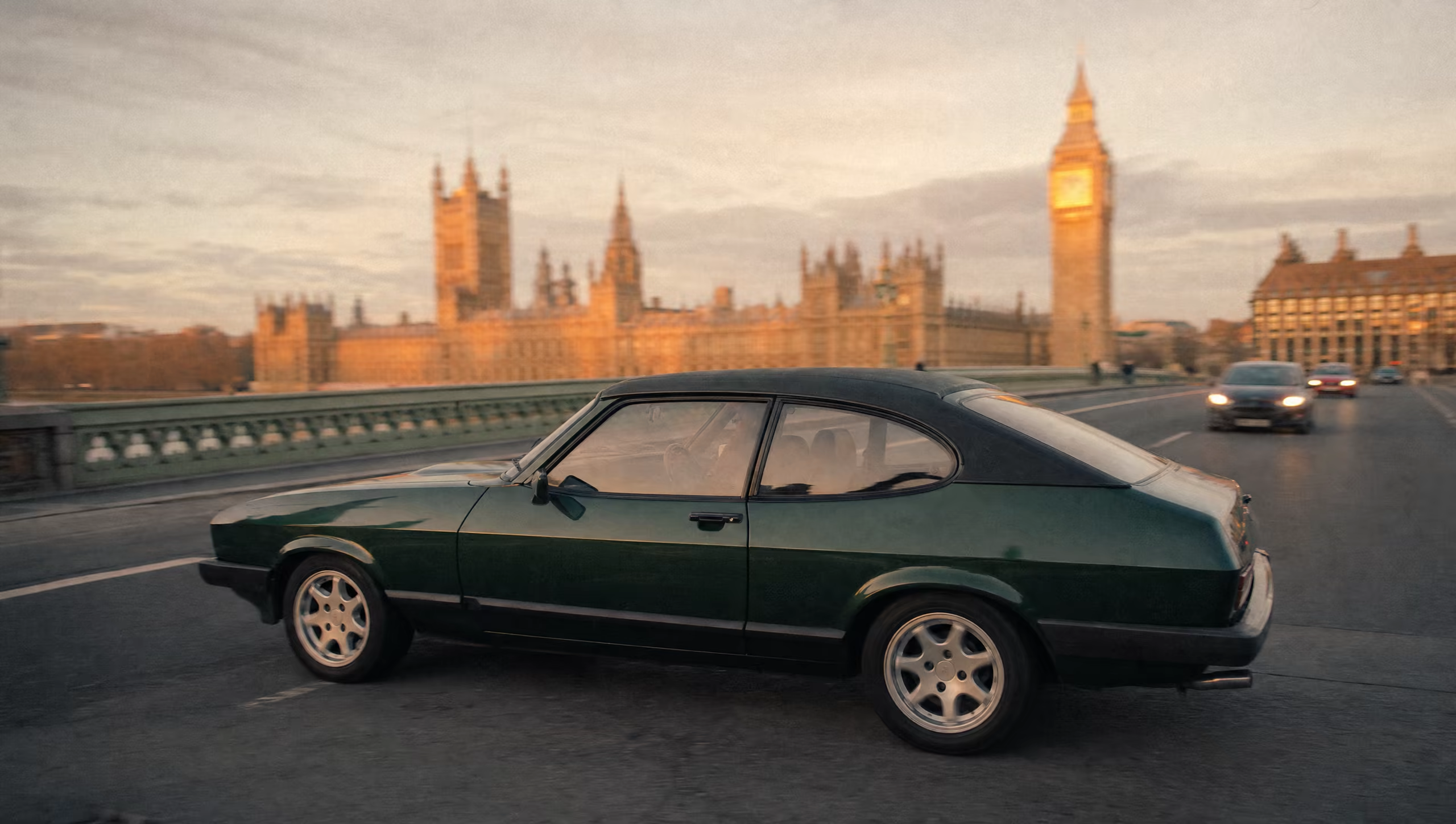
That brings in a fine crop of mid-eighties metal, including the very last Capris. As the Capri 280 Group will be reminding everyone at next week's NEC Classic Motor Show, the Capri bowed out with 1,038 Capri 280s, and the last one rolled off the line on 19 December 1986. They go tax-free in April.
Two things to know before you queue at the Post Office. It isn't automatic: the first switch into the historic class still has to be done over the counter, with the V5C and either a current MOT or a V112 declaration that the car is exempt. And it goes by build date, not registration date. Cars built at the end of a year were often not registered until the next, so check what the DVLA has on file. If its record goes by a 1987 registration, its INF34 leaflet explains the evidence it needs to accept a 1986 build date, usually a manufacturer's record or a Glass's extract with a covering letter from the club.
Moving into the class also brings exemption from London's ULEZ and the clean air zones in Birmingham and Bristol, which for a regular visitor can be worth more than the tax itself.
What the Treasury wouldn't do is promise anything beyond 2027. When Alison Griffiths MP asked whether the government planned to freeze the qualifying date, the Treasury's answer on 26 October was that the Chancellor "does not routinely comment on proposals". It is the Treasury's standard non-answer. Before the November 2025 Budget, MPs were told only that the government "annually reviews the rates and thresholds" of taxes, and that Budget then left the exemption alone. But because the rule rolls itself, a freeze would need a change to the law, most likely announced in a Budget. So keep an eye on the next one.
Fuel duty jumps 7.64p a litre on 1 July
The 5p fuel duty cut, which was due to start unwinding in January, now lasts until 30 June 2027. Then the bill arrives all at once. On 1 July, duty on petrol and diesel goes from 52.95p to 60.59p a litre, because the end of the cut and a postponed inflation rise land on the same day. With VAT on top that is about 9p a litre at the pump by my arithmetic, or roughly £5.50 every time you fill a 60-litre tank, arriving in the middle of the rally and touring season. Anyone setting entry fees for summer 2027 events should allow for it.
Clubs that run historic tractors and machinery on red diesel get the same treatment: an extra 3.7p cut lasts until 30 June, then the rate jumps from 6.48p to 11.65p a litre.
As for the fuel itself, relax. Nobody has decided to phase out E5 super unleaded. The law that keeps it on sale at larger filling stations has no end date, although the review report the government was supposed to publish by 1 September 2026 still hasn't appeared.
Oxford's traffic filters catch classic cars
Clean air zones have always let historic cars through. Oxford's new traffic filters don't. Since 28 September 2026, six experimental filters in the city have stopped private cars at set times: Hollow Way and Marston Ferry Road from 7 to 9am and 3 to 6pm, and St Clement's Street, St Cross, Hythe Bridge Street and Thames Street from 7am to 7pm, every day of the year.
Permits go to residents, Blue Badge holders, carers and similar groups. There is nothing for historic cars, and classic motorhomes are caught too. The penalty is £70, or £35 if you pay within 21 days. First offences get a warning during the first six months, which by my reckoning ends around 28 March 2027. Oxford's separate zero emission zone does exempt historic vehicles, which is a comfort, but the filters are what will catch a club run through the city. If your spring run passes through Oxford, plan the route now.
Martyn's Law reaches the bigger club shows
The Terrorism (Protection of Premises) Act 2025, better known as Martyn's Law, is expected to come into force in spring 2027, and the FBHVC says April. It will put duties on premises that include a building, used for one of the purposes the Act lists, where 200 to 799 people may be present at once, staff included (the standard tier), and heavier ones on events with 800 or more people on site at once, again counting staff, where entry is checked by ticket, pass or membership (the enhanced tier). The government's own estimate of average costs is £330 a year for the standard tier and £5,210 for the enhanced.
Most club runs and small shows look to sit outside it, and an outdoor show with no building and fewer than 800 people is outside it altogether. A show, concours or autojumble with 800 or more people on site at once probably won't be, and because checking membership cards at the gate counts as an entry check, a members-only event of that size is not exempt just for being members only. The Security Industry Authority's final guidance is due this autumn, and the FBHVC, which says its lobbying got the lower threshold raised from the 100 first proposed and which has volunteered to test the regulator's notification system, advises organisers not to buy compliance products yet. That seems wise. Anyone selling Martyn's Law kits before the guidance is out is selling guesswork.
The DVLA's new restoration rules
This one has already happened, but it's the biggest change of the lot for restorers and clubs. In two stages, in August 2025 and August 2026, the DVLA rewrote its rules for restored and modified cars, and the points system went in the first. The FBHVC calls the second stage the final one. A like-for-like shell or chassis replacement can normally keep the car's identity, subject to the DVLA's checks and your receipts and photographs, and is reported on form V627/1, while structural modifications and electric conversions are reported on V627/3. Reconstructed classics now need every major part to be over 40 years old (it used to be 25) and must be inspected and dated by an owners' club. The V765 form for reclaiming an original number was reissued on 27 October, and the list of clubs that can back one on 6 November.
I've covered it all in detail in DVLA classic car rule changes: the new restoration rules explained.
The MOT exemption runs on a different clock
This is worth repeating, because it's the commonest mix-up in club newsletters: the MOT exemption has nothing to do with 1 April. A car can stop having MOTs once it was built or first registered more than 40 years ago, provided it is a type no longer in production and hasn't been substantially changed in the last 30 years, and the keeper declares the exemption when taxing it. So cars built in late 1986 become MOT-exempt over the next few weeks, months before they can join the tax class.
The Department for Transport updated its guidance on what counts as "substantially changed" in March and May 2026, and the DVLA reissued the V112 exemption declaration on 3 June, so old copies of both belong in the recycling.
The electric car tax quirk
Here's a wrinkle I haven't seen reported anywhere. From 1 April 2028, under draft law, electric cars will pay a new electric vehicle excise duty of 3p a mile, and plug-in hybrids 1.5p. The Treasury's consultation response says petrol and diesel cars converted to electric "will also be out of scope of the tax upon its introduction", which would please anyone who has put an electric motor in their Morris Minor. But I can't find the clause that does that in the draft law, so converters should wait for the final Finance Act.
The same draft law, published in July 2026, takes the historic class exemption away from any car that meets its definition of an eVED vehicle, which is a passenger car with up to eight seats that is zero-emission or a plug-in hybrid, leaving it on a £0 annual rate plus the mileage charge. The draft fixes that status at first registration, which is what keeps converted classics out. So on my reading, if the final scope stays as drafted, an originally electric car old enough to be historic would pay the mileage charge, about £60 a year at 2,000 miles. It may yet be tidied up before it becomes law, but it's worth knowing about now.
Penalty points and eyesight tests: still waiting
The government's Road Safety Strategy, published on 7 January 2026, launched consultations on several things that matter to classic owners. The penalties consultation proposed three points for not wearing a seat belt and considered points and vehicle seizure for driving without an MOT or with illegal number plates, along with a lower drink-drive limit in England and Wales. A separate consultation proposed compulsory eyesight tests when drivers renew their licence from 70. Both closed on 11 May 2026. The government promised a summary of responses to the penalties consultation within three months, and none had appeared by November.
For classic owners the seat belt rule should change little, because it only applies where belts are fitted. The MOT one could matter more: if points for driving without an MOT arrive, wrongly claiming the exemption on a substantially changed car becomes an expensive mistake. And with the average historic vehicle owner now 66, according to the FBHVC's 2025 survey, the eyesight tests would reach a lot of club members.
More money for restoration apprentices
Restorers have been complaining about the skills shortage for years, and the government has put a little more money on the table. Since April 2024 it has paid all training and assessment costs for apprentices aged 16 to 21 at employers who don't pay the apprenticeship levy, which covers most restoration businesses, and for starts from 1 August 2026 that runs to age 24. A new £2,000 hiring payment applies to 16 to 24-year-olds starting from 1 October 2026, and the existing £1,000 for 16 to 18-year-olds still stands, though the £2,000 payment can be changed or withdrawn during the year, with three months' notice.
The route is the Level 3 Heritage Engineering Technician apprenticeship, with a £26,000 funding band, run through the FBHVC's Federation Skills Trust and the Heritage Skills Academy. On my reading, a small restorer taking on a 17-year-old this winter pays nothing towards the training and receives £3,000. The wages and the patience are still on you.
I have since written up the whole picture on classic car restoration apprenticeships, with a worked example of what one costs and what clubs can do.
The smaller print
- The London Congestion Charge went up from £15 to £18 a day on 2 January 2026, and there is still no discount for historic cars, even ones exempt from ULEZ.
- HMRC updated its guidance on importing a genuine collectors' car at an effective 5% VAT on 2 November 2026, and withdrew VAT Notices 718 and 718/1, moving the margin scheme rules for dealers into new guidance.
- Black and silver number plates remain legal only on cars built before 1973, or built on or before 1 January 1980 and taxed as historic, and the police have been running a crackdown on illegal plates since 5 September 2026.
- A proposed law against removing catalysts, particulate filters and other emissions equipment is pencilled in to be passed in summer 2027, with a six-month lead-in before it applies. The proposal only covers vehicles first used from 1 January 2001, so older classics are outside it.
- From 6 April 2027 the Business Asset Disposal Relief limit halves to £500,000, which matters if you're planning to sell a restoration or dealing business.
- Motorsport UK added a road-section top-up insurance policy for permitted road events from 5 May 2026, at £25 to £60 a head, and gave historic road rallies their own regulations in October.
- In Wales the 20mph default stays. The Senedd rejected a motion to scrap it on 30 September 2026.
- The FBHVC has a new chairman, Karl Carter, who led its heritage apprenticeship scheme, and its 2025 survey values the historic vehicle movement at £7.3 billion a year.
Dates for the diary
| When | What happens |
|---|---|
| 16 January 2027 | FBHVC Club Expo, British Motor Museum, Gaydon |
| By March 2027 | DVLA aims to let you tax through its online account |
| About 28 March 2027 | Oxford traffic filters: first-offence warnings end, by my reckoning (six months from the start) |
| 1 April 2027 | Cars built before 1 January 1987 can join the historic tax class; vehicle tax rises with inflation |
| 6 April 2027 | Business Asset Disposal Relief limit halves to £500,000 |
| Spring 2027 | Martyn's Law expected to come into force |
| 25 April 2027 | Drive It Day |
| 30 June 2027 | Last day of the 5p fuel duty cut |
| 1 July 2027 | Fuel duty rises from 52.95p to 60.59p a litre |
| Summer 2027 | Emissions tampering law proposed to be passed, with six months before it applies (cars first used from 2001 only) |
| 16 October 2027 | FBHVC AGM, British Motor Museum, Gaydon |
| Awaited | Decisions on seat belt, MOT and number plate penalties; eyesight tests from 70; the E5 review |
| 1 April 2028 | Pay-per-mile tax for electric cars begins (draft law) |
Every rule mentioned here, with a link to the official page that decides it, is in our new guide to classic car rules in the UK. Bookmark it, and if anything changes before I spot it, tell me.
The official sources behind this article
- Written answer 37181, 28 October 2026UK ParliamentThe Treasury confirming the 1 April 2027 roll.
- Written answer 37029, 26 October 2026UK ParliamentThe Treasury declining to say whether the qualifying date will be frozen.
- Budget 2026: rates and allowances (Annex A)HM Treasury, 28 October 2026Fuel duty and vehicle tax rates for 2026-27 and 2027-28.
- About the traffic filtersOxfordshire County CouncilFilter locations, times and penalties.
- Understanding Martyn's Law and the SIA's role as regulatorSecurity Industry AuthorityWhether a club event is in scope.
- Historic (classic) vehicles: MOT exemption criteriaDepartment for TransportThe substantial change test, updated in 2026.
- Electric Vehicle Excise Duty (eVED)HMRC and HM TreasuryThe pay-per-mile tax, with its draft legislation.
- The introduction of Electric Vehicle Excise Duty (eVED): consultation responseHM Treasury, 13 July 2026The promise that converted cars will be out of scope at launch.
- Proposed changes to penalties for motoring offencesDepartment for TransportWhere the penalty points decision will appear.
- Vehicle registration: repairs and restorationsDVLAShell and chassis replacement, the V627/1, and when a Q registration follows.
- Regulating environmental impact of in-use emissions of road vehiclesDepartment for Transport, consultation closed 6 September 2026The tampering proposal, its 2001 cut-off and the summer 2027 timetable.
- The Motor Fuel (Composition and Content) and the Biofuel (Labelling) (Amendment) (No. 2) Regulations 2021, regulation 15legislation.gov.ukThe review clause behind the E5 report that was due before 1 September 2026.
- Apprenticeship funding rules: 2026 to 2027GOV.UKFree training for under-25s and the £2,000 payment.
Welcome aboard. A confirmation is on its way to your inbox.
Share this article

Related Articles

Classic car restoration apprenticeships: new £2,000 hiring payment explained
From 1 August 2026 the government pays the whole training bill for a heritage engineering apprentice aged 16 to 24 at a small restorer, and from October it adds a £2,000 hiring payment. Here is what that buys, what a restorer still has to find, where the apprentices learn the trade, and why the clubs are the missing piece.
Read More: Classic car restoration apprenticeships: new £2,000 hiring payment explained
Whose photographs were in this 1953 Beetle's glovebox? The search has reached Takeley
A crumpled set of colour negatives sat in a yellow split-window Beetle's glovebox for half a century. A Bedfordshire restorer has traced the street they were taken on, and now he needs the people.
Read More: Whose photographs were in this 1953 Beetle's glovebox? The search has reached Takeley
DVLA classic car rule changes: the new restoration rules explained
The points system has gone, a replacement shell now means a form rather than a fight, reconstructed classics need 40-year-old parts and a club inspection, and the V765 has just been reissued. What it all means for owners, clubs and restorers.
Read More: DVLA classic car rule changes: the new restoration rules explained