
- What changed, in a paragraph
- Repairs need nothing, shell swaps need a form
- Modifications and electric conversions
- Reconstructed classics: 40 years, not 25
- Specials, new bodies and factory kits
- Getting the original number back
- The MOT wrinkle
- What clubs should do now
- What restorers should do now
- The official paperwork
For as long as most of us have been spannering, restoring a classic came with a nagging worry about the DVLA. Replace too much of the car and a points system could decide it was no longer the same car, taking its identity and quite possibly its registration number with it. The rules were perfectly clear to a DVLA caseworker and baffling to nearly everyone else.
That worry has largely gone. In two stages, in August 2025 and August 2026, the DVLA rewrote its rules for restored, modified and rebuilt vehicles. The points have been scrapped, a like-for-like shell swap is now a matter of filling in a form, and reconstructed classics have been brought into line with the 40-year rule. The second tranche, which the FBHVC calls the final one, landed on 3 August 2026, and the DVLA has since reissued its V765 form for reclaiming original numbers (on 27 October) and its list of approved clubs (on 6 November).
What changed, in a paragraph
After a 2024 call for evidence drew 1,371 responses, the DVLA scrapped its old "rebuilt" and "radically altered" vehicle policies from 26 August 2025, and the points system went with them. Like-for-like repairs and restorations now need no notification, as long as the V5C's vehicle details don't change. A like-for-like replacement chassis, monocoque or frame can normally keep the car's identity, subject to the DVLA's checks, but must be reported. A structural modification or an electric conversion also keeps the identity, and is reported on a different form. Then on 3 August 2026, the second tranche tightened the rules for reconstructed classics to 40-year-old parts and a compulsory club inspection, while opening the door to newly built bodies on separate-chassis cars, period Specials and cars that left the factory as kits. GOV.UK's registration guide no longer has a "radically altered" section at all.
Repairs need nothing, shell swaps need a form
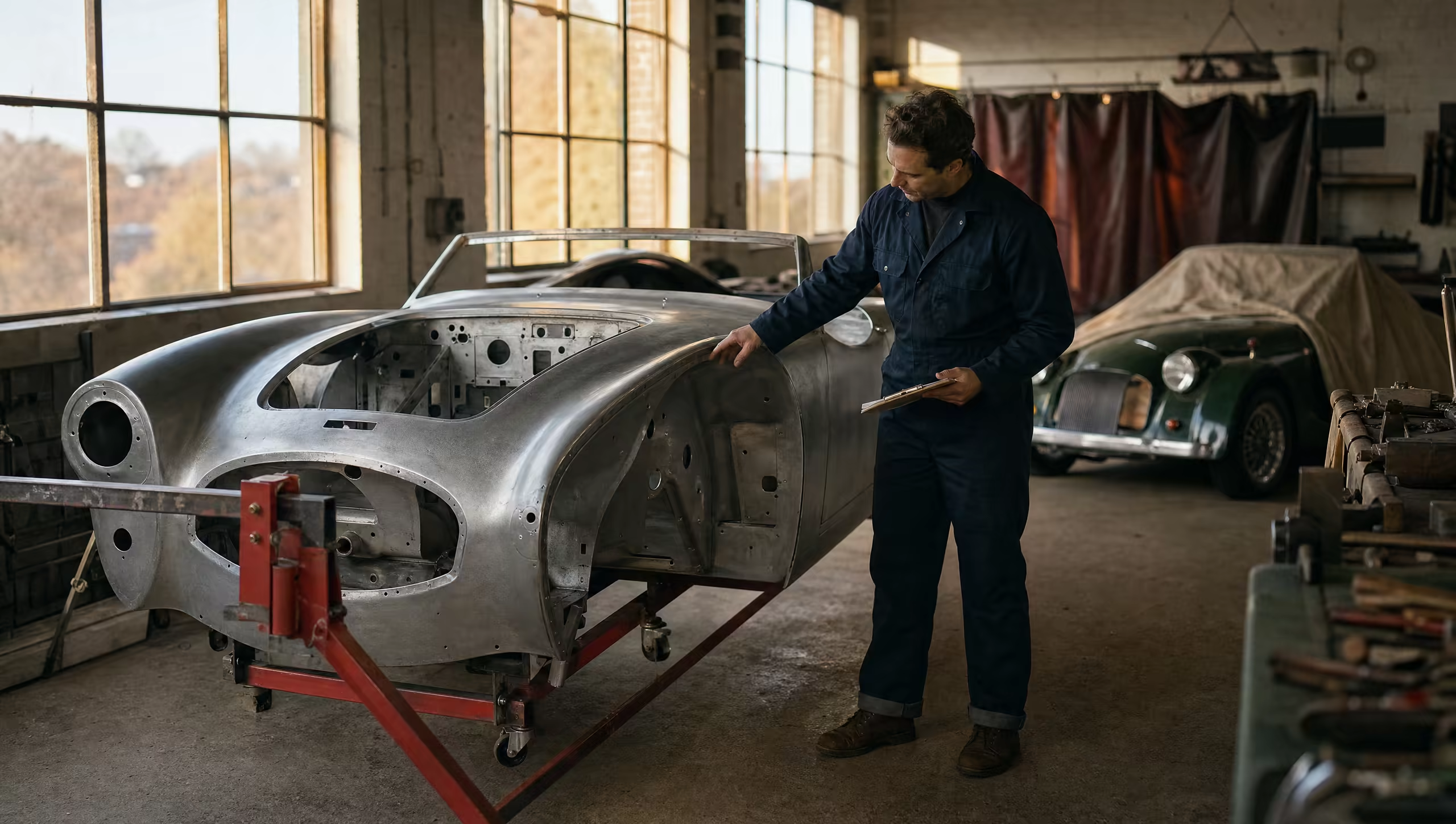
The line between a repair and everything else is now physical rather than a points score. Cutting into a chassis or shell to repair it, replacing a rusted section for instance, is a repair, and a like-for-like repair needs no notification however much of the car it involves, as long as the V5C's vehicle details don't change.
Replacing the whole chassis, monocoque or frame like-for-like, with a new or second-hand one, still counts as a repair and can normally keep the car's identity, subject to the DVLA's checks of your receipts and photographs, but it's the one repair you must report, on form V627/1. The order of things matters:
- Before the old shell is cut, photograph every VIN stamping, every VIN plate and the engine number.
- Keep the receipt for the replacement stating its specification, or the donor car's V5C if it came from another car.
- Tell the DVLA once the car is finished, not halfway through.
- The DVLA then authorises re-stamping of the VIN, next to or in the same area as any existing stamping, and issues a new V5C with a marker in its Special Notes.
A couple of warnings, though. The DVLA won't confirm the outcome of a case in advance, so if the car wears a valuable private number, retain it or transfer it before you start. And never reuse a major component from a Category A or B write-off that was issued with a Certificate of Destruction.
Modifications and electric conversions
Cutting into the structure to change the car's appearance or dimensions is a modification. The DVLA's examples are lengthening it, removing the roof, turning a coupé into a roadster, and drilling new holes within 30cm of the suspension, steering, brake or seat belt mountings. Converting the car to electric drive counts as a modification too.
The big change is that modified cars now keep their identity. You report the work on form V627/3 with full details, and if the car is over 40 you must supply an MOT with the notification. The DVLA says it will one day mark V5Cs "Modified" or "Electric conversion", but it gives no date, and uses "Rebuilt" in the meantime.
For electric conversions, the DVLA changes the fuel type and the tax class "where the law allows", and cars first registered from 1 March 2001 must stay in a CO2-based tax class. What no official source says is whether a pre-1986 car keeps the historic tax class, or its MOT exemption, once converted. The movement itself is split. FIVA, backed by the FBHVC, holds that a converted car stops being a historic vehicle, and the FBHVC told the government in 2023 that any conversion should count as a substantial change needing an MOT. The Historic and Classic Vehicles Alliance, the trade body, went the other way this summer and launched professional standards for conversions. Until someone official settles it, assume nothing.
Reconstructed classics: 40 years, not 25
A reconstructed classic is a car rebuilt from genuine period parts of one model, often from more than one donor. This is where the rules changed most. Since 3 August 2026:
- every major component must be over 40 years old (it used to be 25) and a genuine period part of the model's original specification;
- the DVLA always issues its own VIN;
- an owners' club must inspect the car, support it as a true example of the marque and date its components;
- the age-related registration number follows the newest major component;
- the record always carries a rebuild marker, cars dated before 1963 also get a non-transferable marker, and the car needs a current MOT to be registered.
The 40 years now match the historic vehicle definition, and most of the people who answered the 2024 call for evidence had disagreed with the old 25. The effect is to tighten things for younger reconstructions and to make the owners' club the gatekeeper for every reconstructed classic in the country. A mix of period and non-period parts still means type approval and a Q plate, which in turn means an IVA or MSVA test before the car can be registered.
Specials, new bodies and factory kits
The second tranche was good news for three kinds of car that used to fall between the cracks.
Separate-chassis cars may now take a newly built body where the original is beyond repair and no period replacement exists, and factory-option bodies are recognised too. Genuine period Specials, the DVLA's own example being a 1930s chassis carrying 1950s or 1960s glassfibre or aluminium bodywork, can qualify if the club supports the car as a genuine known example of its era. They are numbered by their newest major component, which is usually the later body. And where the overseas assembly date or first registration can't be found, cars that left the factory as completely knocked down kits, to be put together abroad, can now be dated from when the kit was made or dispatched, according to the HCVA and the FBHVC. That matters for British cars assembled overseas and later brought home.
Getting the original number back
The DVLA reissued the V765 form, version 10/26, on 27 October 2026, and the list of clubs that can back an application, V765/1, on 6 November. The list has about 350 entries across cars, motorcycles and other vehicles, and it is the sixth version since February 2025, so check yours is the current one.
The new form spells out the club's part in it:
- the club should have the car inspected by someone not connected with the applicant, and explain in writing if it isn't inspected;
- any listed club can certify copies of precious documents, so owners needn't post an original buff logbook;
- the club may charge a fee, but the owner doesn't have to join;
- a club that supports the application can send it straight to the DVLA.
The evidence has to link that number to that chassis: the old RF60 or VE60 logbook, authorised archive records or other pre-1983 documents. The DVLA charges nothing, sends a V5C within about six weeks if it agrees, and the reclaimed number can never be transferred. If the number can't be proved, the DVLA issues an age-related number on dating evidence instead, which needs a club dating certificate if the maker no longer exists. Where nothing can date the car at all, it gets a Q plate.
What the DVLA still doesn't publish is how a club gets onto the list in the first place, or what standard its inspectors must meet. If yours wants to, the people to ask are the DVLA's Kits and Rebuilds team or the FBHVC.
The MOT wrinkle
There is one loose end, and it's a big one. The DVLA's INF318 leaflet says a club-dated reconstructed classic over 40 "will qualify for the historic tax and MOT exemptions". The Department for Transport's MOT exemption criteria, updated in March and May 2026, say every reconstructed classic counts as substantially changed unless it has been taxed as historic and left unmodified for 30 years, and that "if you cannot confirm that a vehicle has not been substantially changed, you must not claim MOT exemption".
Two government bodies, two answers. Until they agree, follow the DfT and keep the car tested. An MOT costs £54.85 at most, and with the government considering penalty points for driving without one, that is cheap insurance.
What clubs should do now
- Check your club is on the 6 November 2026 V765/1 list.
- Bin old V765 forms, and send members to the GOV.UK publication page rather than a saved PDF, because the file's address changes with every version.
- Write down how your club does V765 inspections and who does them, so the inspector isn't connected with the applicant.
- Decide what you charge for inspections, certified copies and dating certificates, remembering you can't insist on membership.
- If you date reconstructed classics, make sure your process can confirm that every major component is over 40 years old and a period part of the model's original specification.
- Update your handbook and website. The 2018 MOT guidance is out of date, and the "radically altered" section of GOV.UK no longer exists.
What restorers should do now
- Photograph every VIN stamping, plate and engine number before any shell comes off, and keep the pictures with the job file.
- Keep receipts that state the replacement's specification, or the donor's V5C.
- Retain or transfer any private number before you start.
- Report shell swaps on V627/1, and modifications and conversions on V627/3, once the work is finished.
- Book an MOT before you send the paperwork for anything over 40 that you have modified.
- Don't promise a customer that a converted classic will keep its historic tax class or MOT exemption. Nobody official has said it will.
The official paperwork
- Making changes to a vehicle (INF318)DVLA, updated 3 August 2026The restorer's handbook: shell swaps, modifications, electric conversions, Specials and reconstructed classics.
- Vehicle parts statement (V627/1)DVLAFor a like-for-like shell or chassis replacement.
- Modified vehicle statement (V627/3)DVLAFor structural modifications and electric conversions.
- Register a vehicle under its original registration number (form V765)DVLA, October and November 2026The current form for reclaiming an original number, and the clubs that can back it.
- Reconstructed classic vehiclesGOV.UKThe 40-year parts rule and the compulsory club inspection.
- Repairs and restorationsGOV.UKWhat needs no notification, and when a shell swap does.
- Historic (classic) vehicles: MOT exemption criteriaDepartment for TransportThe substantial change test, updated in 2026.
- DVLA backs classic car industry and driving enthusiasts with updated registration policiesGOV.UK, 20 August 2025The announcement of the first tranche.
- DVLA announces final tranche of revisionsFBHVC, 3 August 2026The clubs' reading of the 2026 changes.
Every other rule that touches a classic, from E5 to ULEZ, is in our guide to classic car rules in the UK, with the official source for each. For what else changes next year, see classic car law changes 2027. And if you're looking for a restorer, our restorers directory lists nearly 500 across England.
Welcome aboard. A confirmation is on its way to your inbox.
Share this article

Related Articles
Classic car restoration apprenticeships: new £2,000 hiring payment explained
From 1 August 2026 the government pays the whole training bill for a heritage engineering apprentice aged 16 to 24 at a small restorer, and from October it adds a £2,000 hiring payment. Here is what that buys, what a restorer still has to find, where the apprentices learn the trade, and why the clubs are the missing piece.
Read More: Classic car restoration apprenticeships: new £2,000 hiring payment explained
Whose photographs were in this 1953 Beetle's glovebox? The search has reached Takeley
A crumpled set of colour negatives sat in a yellow split-window Beetle's glovebox for half a century. A Bedfordshire restorer has traced the street they were taken on, and now he needs the people.
Read More: Whose photographs were in this 1953 Beetle's glovebox? The search has reached Takeley
Classic car law changes 2027: what's coming for owners, clubs and restorers
The Treasury has confirmed that cars built in 1986 go tax-free on 1 April 2027, but it won't promise anything after that. Here is everything that changes for classic owners, clubs and restorers next year, and a few things that already have.
Read More: Classic car law changes 2027: what's coming for owners, clubs and restorers