
Table of Contents
- 130 years since the red flag came down
- Who is in the field
- Where to watch, and when
- Saturday on Pall Mall
- Friday: the Somerset Hoard goes under the hammer
- What I will be watching
At a quarter to seven on Sunday morning, somebody in Hyde Park will tear up a red flag, and more than 400 cars built before 1905 will set off for the seaside. The quick ones will be in Brighton by ten. The slow ones will be lucky to make it by half past four, just as the light goes. A few will not make it at all, and their crews will spend the afternoon on a verge in Surrey with a spanner and a stiff upper lip.
It is the RM Sotheby's London to Brighton Veteran Car Run, the world's longest-running motoring event, and this year it is 130 years since the drive that started it. It also rounds off a busy weekend in London that begins on Friday, with an auction of seven early cars nobody has touched since 1939. Watching all of it costs nothing.
130 years since the red flag came down
Until 1896 the law treated a motor car much like a traction engine. Out of town it was held to 4mph, and someone had to walk ahead of it. The Locomotives on Highways Act of that year raised the limit for light motor vehicles to 14mph and did away with the man on foot, who is remembered in the red flag he was once made to carry.
On 14 November 1896, the day the new law came in, 33 motorists drove from London to Brighton to celebrate. It became known as the Emancipation Run. It has been re-run in memory of that day since 1927, and has started in Hyde Park since 1936. This year is the 130th anniversary of the original. It is also 140 years since Karl Benz patented his Motorwagen, which most people count as the first proper car.
The red flag is torn at 6.45am. The first cars go at 6.53am, as the sun comes up.
Who is in the field
The Royal Automobile Club, which runs the event, has more than 400 cars entered from around 100 makes, the biggest entry in years. More than 100 have come from abroad, from Europe, the USA, Hong Kong and Australia. They run on steam, electricity and petrol, and a growing number of the petrol cars run on sustainable fuel.
The oldest are a Benz Velo from 1894 and a pair of 1895 Peugeots, which should be among the first away. Veteran bicycles and motorcycles, penny-farthings included, are flagged off ahead of them just before dawn.
The car I most want to see is chassis 20154, a 1904 Rolls-Royce 10hp and the oldest Rolls-Royce known to survive. It was the fourth of 17 Type A 10hp cars to carry the name, built as a show car and taken to the Paris Salon in December 1904. Its owner, Terry Bramall, has had it restored over three years to the way it left the works, in primrose yellow on its original Manchester plate, M 612. It has since won its class at Pebble Beach, and Sunday will be its first Run in many decades.
Elsewhere you will find the oldest surviving Rover, a 1904 car entered by the British Motor Museum, and the oldest surviving Vauxhall. There is also a Benz delivery van that Mercedes-Benz says is its oldest roadworthy commercial vehicle. And for anyone who thinks this is a hobby for the very old, Megan Casey, who is 27, is doing her first Run.
Many cars carry a small facts disc with a QR code. Scan it with your phone and you get the car's history while it is still in front of you. The full 2026 entry list is on the RAC's website.
Where to watch, and when
The cars gather in the paddock on Serpentine Road from 6am, and dawn in Hyde Park is worth setting an alarm for. From there they go up Constitution Hill, past Buckingham Palace, down the Mall, through Admiralty Arch and Trafalgar Square, along Whitehall past the Cenotaph and over Westminster Bridge.
South of the river the field splits. Half the cars take the Red route, down the A23 through Kennington, Brixton and Streatham. The other half take the Blue route, along the Albert Embankment and through Clapham Common, Tooting and Mitcham. The two halves meet again on the A236 north of Croydon and carry on south through Surrey to Crawley, where the crews stop for a break at The Hawth theatre. That stop is closed to the public. Then it is over the South Downs to Madeira Drive. This year the organisers are trying a new, more easterly line from Horley past Gatwick Airport.
The map has both routes and the RAC's suggested viewing times. Move the clock to any time on Sunday, or press play, and it shows roughly where the cars should be and which spots they are passing. Pick a spot from the list to go straight to it.
Sunday 1 November
- Front
- Back
- Constitution Hill and the Mall7am to 8.45am
- Whitehall and Westminster Bridge7.10am to 9am
- Clapham Common Blue7.20am to 9.20am
- Mitcham Blue7.25am to 9.50am
- Coulsdon High Street7.35am to 11.05am
- Merstham7.40am to 11.05am
- Redhill7.55am to 11.35am
- Three Bridges and Crawley8.10am to 2pm
- Handcross High Street8.25am to 2.10pm
- Staplefield8.30am to 2.25pm
- Cuckfield High Street8.50am to 2.35pm
- Brighton, Madeira Drive10am to 4.30pm
Look at how the times stretch the further south you go. In London the field is still bunched up and it is all over in under two hours. By Sussex it has spread across most of the day, with the quick cars long gone and the slow ones still chugging in. The RAC picks out Three Bridges, Staplefield and Cuckfield as good places to stand, and I would agree. A village street gives you room to see, a pub, and a fair chance of watching somebody fix something.
The finish closes at 4.30pm, which is about dusk. Crews who reach the seafront before then get a finisher's medal and a hot toddy.
For the official word, the RAC's route guide has its own Google map and the GPX file. Its spectator route guide is the one to print, and its directions page covers getting to Hyde Park and Madeira Drive. Our event listing has the basics. Wrap up. It will be cold, and you will be standing still.
Saturday on Pall Mall
If you cannot face the early start, Saturday is the gentler way in. The Royal Automobile Club closes Pall Mall to traffic from 10am to 3pm for the St James's Motoring Spectacle. It is free and there are no tickets.
The main event is the St James's Concours, with more than 80 of Sunday's pre-1905 cars lined up along the street. Alan Titchmarsh and Edd China are among the judges, and there is a prize for the best-dressed crew. The 1904 Rolls-Royce will be there as well.
Around it there is a display for the centenary of Britain's first Grand Prix, run at Brooklands in 1926, with a Delage of the type that won it parked next to a Williams FW48. We wrote about that race and its hundred years in the summer. There is also a birthday line-up for the Ford Fiesta and the Volkswagen Golf GTI, both 50 this year, and the Lamborghini Miura, which is 60. All seven generations of Fiesta will be there, which is more Fiestas than most of us have seen in one place since a supermarket car park in 1998.
Later that afternoon RM Sotheby's holds its London Auction at The Peninsula hotel on Grosvenor Place, with bidding from 4pm.
Friday: the Somerset Hoard goes under the hammer
Bonhams' Golden Age of Motoring Sale is the usual curtain-raiser for the weekend, and this year it has a proper story in it. Seven early cars, gathered in the 1930s and kept by one family ever since, have been hidden away and untouched since the Second World War broke out. Bonhams calls them the Somerset Hoard, after the county where the cars spent most of their lives.
Here is what is in it, with Bonhams' estimates:
- c.1902 Progress£35,000 to £45,000Built by the short-lived Progress Motor Co of Coventry, with a De Dion-Bouton engine and its Progress hubcaps still on.Old enough, if the date stands
- c.1903 Baker electric£35,000 to £45,000An American electric car made for the English market, steered by a tiller on the right. It was first registered in Bristol, and its history puts it in Scotland in 1915 and Tewkesbury in 1918.Old enough, if the date stands
- c.1903 Darracq 12hp twin-cylinder£55,000 to £75,000A four-seater you climb into from the back.Old enough, if the date stands
- c.1904 Swift£35,000 to £45,000A De Dion-engined car with a removable groom's seat at the back, built by the coachbuilders Hollick and Pratt.Old enough, if the date stands
- Rover 8hp£25,000 to £35,000Two seats, plus two more for occasional passengers.No year given
- 1905 Humber 8/10hp two-seater£20,000 to £30,000Just misses the cut-off
- 1913 Belsize 10/12hp four-cylinder£10,000 to £15,000Eight years too young
Add it up and the seven come to somewhere between £215,000 and £290,000.
Not all of them would get a place on Sunday. The Run takes cars built before 1 January 1905, so the 1913 Belsize is eight years too young and the 1905 Humber just misses. The Progress, the Baker, the Darracq and the Swift all carry dates from the right side of the line. But that little "c." in front of each year means nobody is quite sure, and to enter the Run a car needs either a dating certificate or a Veteran Passport from the Veteran Car Club of Great Britain. Whoever buys one will be doing some homework.
The hoard cars are not the dearest in the sale. The highlights are led by a 1904 Rochet-Schneider 16/22hp side-entrance tonneau at £380,000 to £530,000, and two 1901 Panhard et Levassors at £270,000 to £325,000 and £300,000 to £350,000. There is also a 1904 Darracq 10hp swing-seat tonneau at £150,000 to £200,000. That is the same make and year as Genevieve, star of the 1953 film that did more for the Run than any advert ever could.
The sale is at Bonhams' New Bond Street rooms on Friday 30 October. The motoring memorabilia starts at 1pm and the cars follow at 5pm. You can view on Thursday and Friday from 9am to 5pm.
What I will be watching
The hoard is the test. Cars that have sat for 87 years will not start on the button, and whoever buys them faces a long winter of careful work before any of them goes near a road. Against that, a car nobody has fiddled with since 1939 is about as honest as old cars get.
At the Goodwood Revival in September buyers turned up in force and then refused to pay last year's prices, however good the story. The Somerset Hoard is nothing but story. If the Progress and the Swift go well over their estimates, the veteran world is still happy to pay for a past it can check. If they struggle, then even a car untouched since 1939 has to be priced right, and that would surprise me a little.
We will have the results next week. Until then, set an alarm for Sunday and pick a village. Some of these cars are older than powered flight, they are still doing the job they were built for, and people still line the road to cheer them on. I cannot think of a better way to spend a November morning.
Welcome aboard. A confirmation is on its way to your inbox.
Share this article

Related Articles
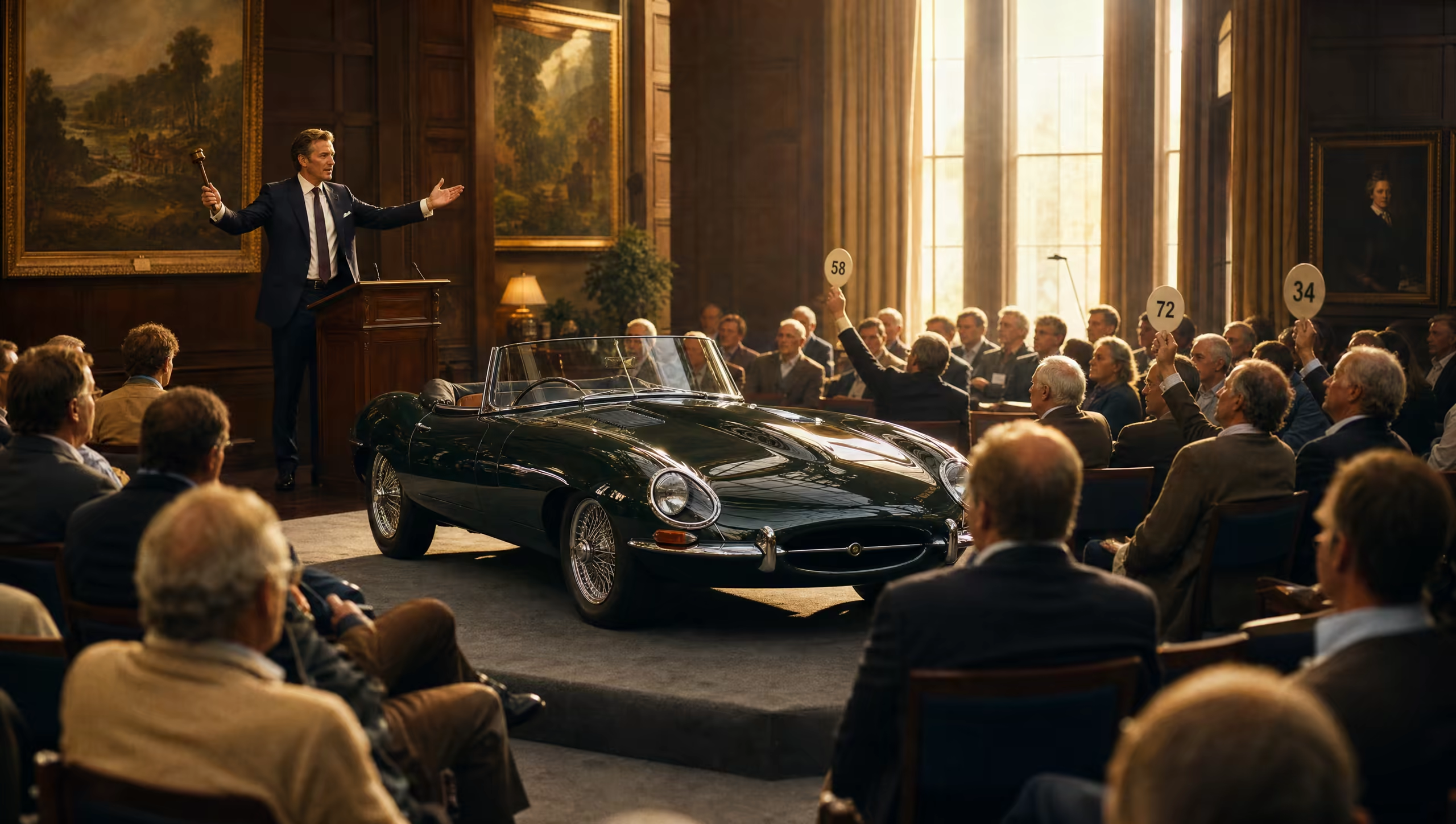
UK classic car auction results 2026: 68 sales, £164 million, and a market that split in two
I have been through every UK classic car sale with a published result this year, plus the big American and European ones for comparison. Two RM Sotheby's sale days made a third of the money. Everywhere else the price of an honest car has reset, and the regional rooms are quietly clearing three quarters of their lots. Month by month, house by house, region by region, with the charts and tables to prove it.
Read More
NEC Classic Motor Show 2026: the debutants, Clarkson's cars and a £16m sale
Seven halls, 3,000 cars and bikes, and 320 clubs told to bring something new. What to find at the NEC this November, which day to go, and the lots I will be watching at Iconic's biggest sale yet.
Read More
CarRust.co.uk review: the free rust handbook every classic owner should have bookmarked
Our sister site has grown into a seventy thousand word handbook on stopping rust in the British climate, and it does not cost a penny. Here is what is on it, which pages are worth your evening, and where it still needs a lick of paint.
Read More